
The Space You Need Costs More Than You Think. The Right Area Costs Less Than You Expect.
The maths of renting a family apartment in Dubai does not work the way most people assume before they start looking.
A couple arrives with two children and a vague sense that a 3-bedroom should cost roughly 50% more than a 1-bedroom. They search. They find 3-bedrooms in Dubai Marina for AED 160,000 per year. They rethink the move entirely.
Then someone tells them about Mirdif. Or Al Barsha. Or Jumeirah Village Circle. Or Bur Dubai.
Suddenly there are 3-bedrooms for AED 90,000–110,000 per year. Larger floor plans than the Marina options. Better community facilities for children. In some cases a school within the community. A garden or a ground-floor terrace. And no sea view — which, for a family that is in the apartment rather than looking at it, matters considerably less than the Instagram version of Dubai living suggests it should.
The 3-bedroom apartment market in Dubai has a wider price range than almost any other property category in the city. The gap between the cheapest and most expensive 3-bedroom can exceed AED 150,000 per year. Understanding what drives that gap — and which end of it suits your family's actual priorities — is the entire point of this guide.
Reality Check: The Price Gap Between Areas Is Larger Than Any Other Apartment Size
The bigger the apartment, the more dramatically the area drives the price. For studios and 1-bedrooms, the price gap between premium and affordable areas in Dubai runs to approximately AED 40,000–60,000 per year. For 3-bedroom apartments, the same premium-to-affordable gap runs to AED 100,000–150,000+ per year.
This means the area decision for 2 and 3-bedroom family apartments is proportionally more consequential than for smaller units. A family choosing between a Downtown 3-bedroom at AED 200,000 per year and a Mirdif 3-bedroom at AED 90,000 per year is not making a slightly different choice. They are making a decision that over three years of tenancy represents a AED 330,000 difference — enough to fund international school fees for a year, a car, and a significant financial buffer simultaneously.
The second reality most families encounter: cheap 3-bedroom apartments in Dubai are not always what the listing represents. The word "cheap" in Dubai property listings frequently signals one or more of the following — an older building with ageing infrastructure, a 3-bedroom that is functionally sized as a 2-bedroom with a small third room that barely fits a single bed, a ground-floor unit with limited light, or a location with commute distances that the listing photographs do not convey.
The third misconception families carry into the 3-bedroom market: that school proximity is automatically addressed by choosing a "family-friendly" area. It is not. School districts in Dubai are not geographically zoned the way they are in many Western countries. Your school is your school regardless of where you live — and the daily school run commute from your apartment to your chosen school is a calculation that needs to happen before you sign a lease, not after.
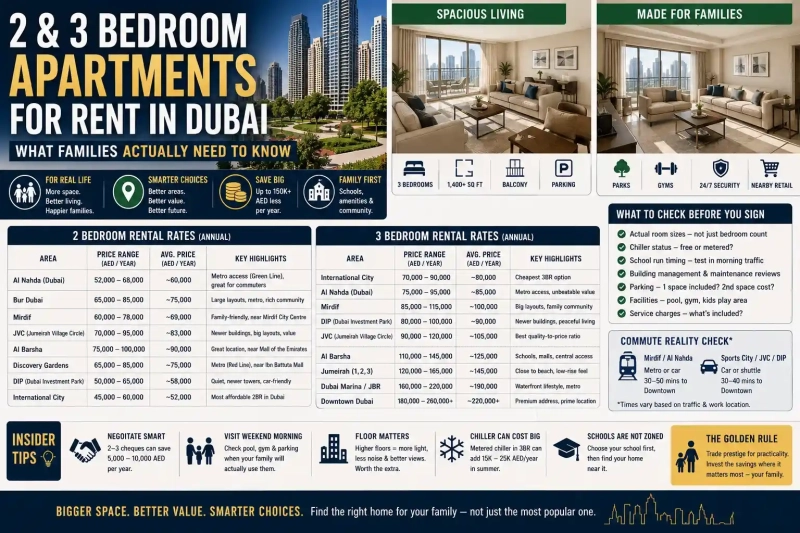
2 Bedroom Apartments for Rent in Dubai — Area and Price Breakdown
What AED 55,000–75,000 Per Year Gets You
At the lower end of the 2-bedroom market, the areas delivering genuine value are:
Al Nahda (Dubai): 2-bedrooms from AED 52,000–68,000 per year. Metro-connected, practical for families on a tight budget who need the Green Line for daily commuting. Building quality at this price point in Al Nahda is functional rather than impressive — expect older finishes, smaller room dimensions, and shared facilities that get the job done without being exceptional. Best suited for families prioritising transport connectivity and rent economy over environment quality.
International City: 2-bedrooms from AED 45,000–60,000 per year. The most affordable 2-bedroom option in Dubai. The community is well-established and has a genuine neighbourhood character — but building quality and maintenance vary significantly between clusters. Not suited for families whose lifestyle requires proximity to Dubai's western corridor or frequent car-free mobility.
Dubai Investment Park (DIP): 2-bedrooms from AED 50,000–65,000 per year. Quieter than International City, newer building stock in several zones, and practical for families working in the Jebel Ali or Dubai South employment corridor. Limited community retail and dining within walking distance.
Mirdif: 2-bedrooms from AED 60,000–78,000 per year. One of Dubai's most established family communities. Larger apartment floor plans than most equivalent-priced alternatives, good community character, proximity to Mirdif City Centre mall, and a genuine neighbourhood feel that distinguishes it from purpose-built high-rise communities. No metro access — car-dependent — but consistently ranked among the most liveable affordable family areas in Dubai by long-term residents.
What AED 75,000–110,000 Per Year Gets You
This mid-range bracket is where the quality-to-price ratio for 2-bedrooms peaks in Dubai.
Jumeirah Village Circle (JVC): 2-bedrooms from AED 70,000–95,000 per year. Newer buildings, improving community infrastructure, and a central enough location to make the lack of metro access manageable for most car-owning families. Floor plans at this price point in JVC are among the most generous in their bracket — 1,100–1,400 sq ft for a 2-bedroom is common, versus 850–1,000 sq ft in older central Dubai buildings at similar or higher pricing.
Al Barsha: 2-bedrooms from AED 75,000–100,000 per year. Established area with excellent road connections, proximity to Mall of the Emirates, and a broader community character that suits families. A mix of older and newer buildings — the newer buildings in Al Barsha South are worth targeting for families who want better finishes without moving to a more expensive area.
Discovery Gardens: 2-bedrooms from AED 65,000–85,000 per year. Red Line metro connected, adjacent to Ibn Battuta Mall, and offering good value per square foot. Building quality varies by cluster — the Mediterranean cluster is consistently well-regarded.
Bur Dubai: 2-bedrooms from AED 65,000–85,000 per year — covered in detail below.
2 Bedroom Apartments for Rent in Bur Dubai
Bur Dubai is one of Dubai's oldest established residential areas and one of the most underappreciated by new arrivals who focus on western Dubai communities without considering the value available on the eastern side of the creek.
2 bedroom apartments for rent in Bur Dubai at AED 65,000–85,000 per year deliver:
- Some of the largest floor plans available at this price in Dubai — older buildings in Bur Dubai were designed with larger room dimensions than modern value-engineered developments
- Green and Red Line metro access (via nearby Bur Juman station — one of the two main interchange stations in the network)
- Walking distance to a wide range of dining, retail, and everyday services
- Proximity to the historic areas of Dubai — the Dubai Museum, Textile Souk, and the creek — which families with school-age children find genuinely enriching
- A diverse, established community character very different from the transience of newer high-rise communities
What Bur Dubai does not deliver: new building aesthetics, modern fitness facilities, or the lifestyle environment of Marina or Downtown. Buildings in Bur Dubai are older — this is reflected in finishes, lift quality, and in some cases building management responsiveness. Viewing the specific building (not just the area) is essential.
For families who value character, floor space, metro connectivity, and an authentic urban Dubai experience over glossy new-build aesthetics, Bur Dubai 2-bedrooms represent some of the best value in the city at their price point.
3 Bedroom Apartments for Rent in Dubai — Area and Price Breakdown
Cheap 3 Bedroom Apartments — AED 75,000–110,000 Per Year
The cheap 3 bedroom apartments for rent in Dubai market is concentrated in a specific set of areas that deliver genuine livability at significantly below the city average for this apartment size.
Mirdif: 3-bedrooms from AED 85,000–115,000 per year. The most consistently recommended affordable 3-bedroom area for families in Dubai. Larger villas and apartments than most communities at this price, a community-oriented environment, proximity to good schools on the eastern Dubai corridor, and Mirdif City Centre for everyday retail needs. The trade-off is no metro access and distance from the western Dubai employment and lifestyle corridor.
International City: 3-bedrooms from AED 70,000–90,000 per year. The cheapest genuine 3-bedroom option in Dubai. Quality and management vary substantially between clusters — this requires more viewing effort than most areas to find a unit that actually delivers what the price implies.
Al Nahda: 3-bedrooms from AED 75,000–95,000 per year. Metro access at this price for a 3-bedroom is genuinely rare in Dubai. Building quality is older and the living environment is dense, but the transport connectivity is a meaningful practical advantage for families without multiple cars.
Dubai Investment Park: 3-bedrooms from AED 80,000–100,000 per year. Newer building stock, quieter community, good value per square foot for the quality delivered. Car-dependent.
Jumeirah Village Circle (JVC): 3-bedrooms from AED 90,000–120,000 per year. The best quality-to-price ratio for 3-bedrooms among the mid-affordable communities. Newer buildings, generous floor plans, and improving community amenities make JVC a strong choice for families who want something that feels modern without paying Downtown prices.
Mid-Range 3 Bedrooms — AED 110,000–160,000 Per Year
Al Barsha: 3-bedrooms from AED 110,000–145,000 per year. Good schools nearby, proximity to Mall of the Emirates, established family community character. One of the most practical mid-range 3-bedroom areas for families balancing budget, school access, and daily convenience.
Jumeirah (1, 2, 3): 3-bedrooms from AED 120,000–165,000 per year. Access to beach, established villa-style and low-rise apartment community, strong school corridor along Jumeirah Road. Higher pricing than JVC or Al Barsha but a distinctly different lifestyle offer — lower density, more outdoor space, closer proximity to the sea.
Dubai Silicon Oasis: 3-bedrooms from AED 95,000–125,000 per year. A technology-focused free zone community with strong residential infrastructure. Good value per square foot, newer buildings, and a quieter community character than most mid-range areas. Car-dependent but with good highway access.
Premium 3 Bedrooms — AED 160,000–250,000+ Per Year
Dubai Marina and JBR: 3-bedrooms from AED 160,000–220,000 per year. The Marina lifestyle at 3-bedroom scale. Waterfront access, metro connectivity, and the full Marina community experience — at a price that most families find difficult to justify when the same annual rent difference funds meaningful extras elsewhere.
Downtown Dubai: 3-bedrooms from AED 180,000–260,000+ per year. Premium address, proximity to DIFC and Downtown employment, and the Burj Khalifa backdrop. The most expensive 3-bedroom market in the city outside the Palm.
Dubai Hills Estate: 3-bedrooms from AED 150,000–200,000 per year. Newer development, Emaar management standards, proximity to Dubai Hills Mall and schools within the community. A strong family choice for those who want a premium community feel without the Marina or Downtown price point — though still significantly above mid-range alternatives.
What to Check Before Signing a Family Apartment Lease in Dubai
School run timing, not just distance. Dubai traffic makes distance a misleading proxy for commute time. A school 8 kilometres from your apartment via a traffic-heavy road takes longer than a school 12 kilometres away on a clear route. Test the commute during school drop-off hours — 7:15 to 8:00 AM — before committing to the apartment.
Building floor plan versus listed bedroom count. A 3-bedroom apartment listed at AED 90,000 in Dubai may have a master bedroom, a standard second bedroom, and a third room that is 8 x 10 feet — functionally a study or a very small child's room. Always confirm actual room dimensions, not just bedroom count.
Chiller status for larger apartments. A 3-bedroom with a metered chiller in Dubai can generate AED 15,000–25,000 per year in cooling costs during the summer months. Free chiller (included in rent or service charge) at a slightly higher headline rent is frequently cheaper in total. Always ask about chiller before viewing.
Building management responsiveness for families. Families use apartment facilities more intensively than single occupants — pools, gyms, lifts, parking, and common areas all matter more when you have children. Ask specifically about the management company, the maintenance response time, and check Google reviews for the building name before viewing.
Parking allocation. Most Dubai apartment buildings allocate one covered parking space per unit. For families with two cars, confirm whether a second space is available and at what additional cost before committing.
Insider Tips for Family Apartment Renters in Dubai
JVC is the most underrated family area in Dubai right now. Newer buildings, genuinely large floor plans, improving community amenities, and pricing that sits 30–40% below Marina or Downtown for equivalent bedroom counts. The metro gap is real but manageable for car-owning families, and the community is growing fast enough that the retail and dining infrastructure is catching up with the residential quality.
Mirdif's reputation among long-term Dubai residents is significantly higher than among new arrivals. It consistently ranks as one of the most liveable affordable family communities by people who have actually lived there — not just browsed listings from overseas. The ground-floor apartments with small gardens in Mirdif are particularly popular with families and move quickly when available.
Older Bur Dubai buildings have the largest rooms per dirham in the city. If floor space matters more than finishes — and for families with young children it often does — the building stock in Bur Dubai routinely delivers 200–300 sq ft more living space per year of rent than equivalent-priced newer buildings in JVC or Al Barsha.
The three-cheque option for family apartments is worth pursuing. Landlords in family communities (Mirdif, JVC, Al Barsha) are typically owner-occupiers or long-term investors who value stable, long-term tenants over maximum rent extraction. Offering two or three years tenancy in exchange for a rental reduction of AED 5,000–10,000 per year is a negotiation that succeeds more often in family communities than in high-turnover areas like Marina or Downtown.
Visit the building's pool and gym on a weekend morning. These are the facilities your children will use most. Weekend mornings reveal actual capacity, maintenance standards, and crowd levels — all invisible in listing photos.
Quick Summary and FAQ
What is the average rent for a 3-bedroom apartment in Dubai? The range is enormous — from AED 70,000–90,000 per year in International City to AED 180,000–260,000+ in Downtown Dubai. Mid-range family areas like JVC, Mirdif, and Al Barsha deliver 3-bedrooms at AED 90,000–145,000 per year.
What are the cheapest 3-bedroom apartments for rent in Dubai? International City (AED 70,000–90,000), Al Nahda (AED 75,000–95,000), and Mirdif (AED 85,000–115,000) are the most affordable genuine 3-bedroom options. International City is cheapest; Mirdif delivers the best quality at its price point.
Are 2-bedroom apartments available in Bur Dubai? Yes. Bur Dubai has a substantial 2-bedroom market at AED 65,000–85,000 per year, with larger floor plans and metro connectivity than many comparable-priced alternatives elsewhere in the city.
Is JVC good for families? Yes — increasingly so. Newer buildings, large floor plans, improving amenities, and significant rent savings over Marina or Downtown make it one of the strongest family value propositions in Dubai's current market.
What should I check specifically before renting a 3-bedroom in Dubai? Confirm chiller status (free vs metered), actual room dimensions (not just bedroom count), parking allocation for two cars, building management company and maintenance responsiveness, and school run timing during actual morning traffic.
Is Downtown Dubai worth the premium for a family? For most families, no — the price premium over JVC, Mirdif, or Al Barsha is AED 80,000–150,000 per year for broadly similar lifestyle functionality once children are school-age. The Downtown premium is primarily a lifestyle and prestige choice rather than a practical family necessity.
Related Reading
For families who want to understand the full cost structure of renting in Dubai before committing to a specific area — including agency fees, security deposits, chiller costs, and the DEWA bill reality for larger apartments — the Dubai studio and 1-bedroom monthly rental guide covers the complete financial framework that applies equally to 2 and 3-bedroom apartments.
If you are considering the affordable areas covered in this guide and want to compare them against the 1-bedroom market in the same communities — particularly for smaller families or couples planning ahead — the Dubai affordable 1-bedroom areas guide covers Sports City, Al Nahda, Remraam, and Mirdif in detail, with the commute analysis and area comparisons that apply directly to the 2 and 3-bedroom decision as well.
For families specifically weighing Dubai Marina against more affordable family communities — and wanting an honest breakdown of what the Marina premium actually delivers versus what it costs — the Dubai Marina apartments guide covers the full Marina rental spectrum including the entry-level tier that some families find represents a workable compromise between community quality and rent economy.