
The Two Areas Most New Arrivals Dismiss in the First Five Minutes — And Why That's a Mistake
The conversation goes the same way every time.
A new arrival to Dubai tells someone they are looking for an apartment. The someone asks which areas they are considering. The new arrival lists Marina, JBR, Downtown, maybe Business Bay. The someone — who has lived in Dubai for six or eight years — mentions Deira. Or Bur Dubai.
The new arrival's face does the thing.
"Oh. Is that not... old Dubai?"
Yes. That is exactly what it is. And that is precisely why it deserves more than a five-second dismissal from someone who has been in the country for three weeks and whose entire knowledge of Dubai's residential market comes from property portals filtered to show only the waterfront communities that appear in the Instagram version of the city.
Deira and Bur Dubai are the original Dubai. They predate the Marina by decades. They have metro connections that the Marina corridor only got in 2009. They have neighbourhood infrastructure — markets, souks, restaurants, pharmacies, community character — that purpose-built communities spend ten years trying to grow and rarely achieve at the same depth. And they have 1, 2, and 3-bedroom apartments at prices that make the comparable Marina or Downtown unit look like a different city's rental market entirely.
This guide is for renters who are willing to look at the whole city before deciding. Not just the shiny western part of it.
Reality Check: Deira and Bur Dubai Are Not Outdated — They Are Undervalued
The perception problem that Deira and Bur Dubai carry in Dubai's rental market comes from three sources, none of which accurately represents what living there actually involves.
The first source is building aesthetics. The residential stock in Deira and Bur Dubai is older than in JVC, Dubai Hills, or Business Bay. The lobbies reflect the era in which the buildings were constructed. The lifts are original in some cases. The finishes in the apartments — floor tiles, bathroom fittings, kitchen cabinetry — carry the design sensibility of their construction period, which is not 2024. For renters whose primary criterion is a building that looks like a five-star hotel from the entrance, Deira and Bur Dubai will disappoint. For renters whose primary criterion is liveable space, transport connectivity, and neighbourhood quality at a fair price, the building aesthetic is a distraction from what actually matters.
The second source is the community character. Deira and Bur Dubai have large South Asian, Filipino, Arab, and East African communities alongside a Western expat population. The areas are genuinely multicultural in the way that planned expat communities like the Marina corridor are not — and for some renters this is a strength rather than a drawback. The food, the markets, the street life, and the neighbourhood character that result from this mix are among the most distinctive and genuinely interesting residential environments in Dubai.
The third source is the assumption that "old" means poorly maintained. Some buildings in Deira and Bur Dubai are poorly maintained. So are some buildings in JVC and Sports City. Building management quality in Dubai is a building-specific variable, not an area-level characteristic. The best-managed buildings in Deira and Bur Dubai are well-maintained, responsive, and competently run. The due diligence required before renting — checking the management company, reading building-specific reviews — is identical to what good renters do everywhere in Dubai.
Apartments for Rent in Deira Dubai — Full Breakdown
What Deira Is
Deira is the northeastern quadrant of old Dubai, sitting on the northern side of the Dubai Creek. It is one of the most historically significant commercial and residential areas in the city — the Gold Souk, Spice Souk, fish market, and the traditional dhow wharves all sit within or immediately adjacent to the Deira residential community.
The area is divided into several sub-districts — Al Rigga, Al Nahda (the Dubai side of the Sharjah border), Al Muteena, Salah Al Din, Al Mamzar, Port Saeed, and Deira Islands — each with a slightly different character and price point.
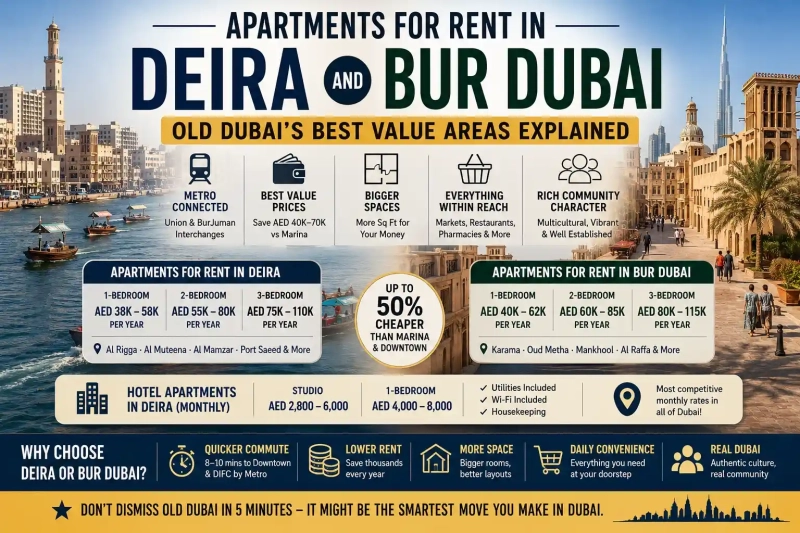
Deira sits on the Green Line of the Dubai Metro. Al Rigga, Union, Salah Al Din, Al Qiyadah, and Abu Baker Al Siddique stations all serve the area. Union Square is the main interchange between the Red and Green lines, making Deira one of the best-connected residential areas in Dubai for metro-reliant commuters.
Deira Apartment Prices
Studio apartments for rent in Deira Dubai:
- Unfurnished: AED 25,000–40,000 per year
- Furnished: AED 32,000–50,000 per year
- Monthly equivalent (unfurnished annual): AED 2,083–3,333 per month
1-bedroom apartments for rent in Deira Dubai:
- Unfurnished: AED 38,000–58,000 per year
- Furnished: AED 48,000–70,000 per year
- Monthly equivalent (unfurnished annual): AED 3,166–4,833 per month
2-bedroom apartments for rent in Deira Dubai:
- Unfurnished: AED 55,000–80,000 per year
- Furnished: AED 68,000–95,000 per year
- Monthly equivalent (unfurnished annual): AED 4,583–6,666 per month
3-bedroom apartments for rent in Deira Dubai:
- Unfurnished: AED 75,000–110,000 per year
- Monthly equivalent: AED 6,250–9,166 per month
These are among the lowest prices available for metro-connected apartments in Dubai — a combination that is genuinely rare in the city's rental market.
Sub-Area Price Differences Within Deira
Al Rigga: The most central and well-connected Deira sub-district. Al Rigga Metro Station sits on a commercial strip with restaurants, pharmacies, and retail. Slightly higher prices within the Deira range due to the convenience factor.
Al Mamzar: The northern coastal sub-district adjacent to Al Mamzar Beach Park. Lower density than central Deira, some sea-adjacent buildings, and a slightly quieter character. Prices comparable to or slightly above central Deira for the beach proximity.
Port Saeed: The commercial district adjacent to the creek and the airport corridor. More business-oriented, with hotel apartments and serviced buildings alongside standard residential stock. Practical for residents working in the airport and free zone corridor.
Al Muteena and Salah Al Din: Denser residential sub-districts with strong everyday retail infrastructure. Lower prices within the Deira range — some of the most affordable metro-connected apartments available in Dubai sit in these sub-districts.
What Deira Delivers That Premium Areas Cannot
Neighbourhood depth. Deira has a genuine neighbourhood character that planned communities take a decade to develop and rarely achieve. The markets, the creek, the street food options, the mix of businesses and residents — this is urban Dubai in its original form and it is genuinely interesting to live in for residents who engage with their environment rather than simply sleeping in it.
Walking-distance infrastructure. The density of Deira means that pharmacies, supermarkets, restaurants, laundrettes, tailors, electronics repair shops, and everyday service businesses are within walking distance in a way that is impossible in low-density planned communities. Car-free living in Deira is not just possible — it is one of the most practical car-free residential options in the city.
Metro connectivity to all of Dubai. The Green Line and the Union interchange give Deira residents access to every metro-connected area of Dubai without a car. Downtown Dubai is 15–20 minutes by metro. Dubai Marina is 35–40 minutes by metro. The airport is 10 minutes by metro.
Apartments for Rent in Bur Dubai — Full Breakdown
What Bur Dubai Is
Bur Dubai sits on the southern side of the Dubai Creek, directly across from Deira. It is the second half of old Dubai — historically the Emirati side of the creek, as Deira was the merchant trading side. The area includes Al Fahidi Historical Neighbourhood (the restored wind-tower district), the Dubai Museum, Textile Souk, and a dense residential and commercial mix that gives it a character completely distinct from any other area in the city.
Bur Dubai is connected to both the Red and Green metro lines via BurJuman Station — one of only two major interchange stations in the network (the other being Union Square). This gives Bur Dubai residents genuinely exceptional metro connectivity to both line directions without requiring a change.
The residential sub-districts of Bur Dubai include Mankhool, Al Raffa, Karama, Oud Metha, and the area immediately surrounding BurJuman mall — each with a slightly different character and price range.
Apartments for Rent in Bur Dubai Prices
Studio apartments:
- Unfurnished: AED 28,000–42,000 per year
- Furnished: AED 35,000–52,000 per year
1-bedroom apartments:
- Unfurnished: AED 40,000–62,000 per year
- Furnished: AED 52,000–75,000 per year
2 bedroom apartments for rent in Bur Dubai:
- Unfurnished: AED 60,000–85,000 per year
- Furnished: AED 75,000–100,000 per year
- Monthly equivalent (unfurnished annual): AED 5,000–7,083 per month
3-bedroom apartments:
- Unfurnished: AED 80,000–115,000 per year
- Monthly equivalent: AED 6,666–9,583 per month
The Bur Dubai Floor Space Advantage
This is the detail that long-term Dubai residents know and newcomers consistently overlook.
Bur Dubai's older residential buildings were built to a different era's standards for apartment sizing. The buildings constructed in the 1990s and early 2000s that form the bulk of Bur Dubai's residential stock were designed with room dimensions that modern value-engineered developments do not replicate. A 1-bedroom apartment in a Bur Dubai building from 2001 will typically be 950–1,150 sq ft. The same "1-bedroom" in a JVC building from 2018 will typically be 700–850 sq ft.
The floor space per dirham available in Bur Dubai is consistently higher than in most newer mid-market areas — particularly relevant for families and for anyone who spends meaningful time in their home rather than treating it purely as a place to sleep.
Karama — The Most Liveable Bur Dubai Sub-District
Karama deserves specific mention within the Bur Dubai breakdown because it represents one of the most consistently liveable value residential areas in the entire city.
Karama has a dense retail strip (Karama Shopping Complex), excellent street food, a strong community character, and proximity to both BurJuman and ADCB Metro Stations on the Red Line. Families and individuals who have lived in Karama routinely describe it as one of the most practical and enjoyable residential areas in Dubai — not despite the density and the market character, but because of it.
Karama 1-bedroom prices: AED 42,000–65,000 per year Karama 2-bedroom prices: AED 65,000–90,000 per year
For renters open to the urban character of old Dubai, Karama is the single most underrated value residential option in the city at its price point.
Oud Metha — The Quieter Bur Dubai Option
Oud Metha sits on the eastern edge of Bur Dubai, adjacent to the Oud Metha Metro Station on the Green Line and close to Lamcy Plaza mall. It is quieter and less dense than Karama or central Bur Dubai, with a mix of apartments and some villa compounds. Prices are broadly comparable to Karama with slightly more residential character and less street-level activity.
For families and residents who want the Bur Dubai metro connectivity and floor space advantage without the full density of central Karama, Oud Metha is the right sub-district to focus on.
Hotel Apartments in Deira Dubai for Monthly Rent
Hotel apartments in Deira Dubai for monthly rent represent the most competitive monthly accommodation market in Dubai. The density of hotel apartment operators in Deira — driven by the area's long history as a business traveller and extended-stay destination — creates genuine competition that keeps pricing more honest than in premium areas.
Monthly hotel apartment rates in Deira:
Studio hotel apartments:
- Budget operators: AED 2,800–4,000 per month
- Mid-range operators: AED 4,000–6,000 per month
- Better-quality branded operators: AED 6,000–8,500 per month
1-bedroom hotel apartments:
- Budget operators: AED 4,000–5,500 per month
- Mid-range operators: AED 5,500–8,000 per month
- Better-quality operators: AED 8,000–11,000 per month
These rates typically include utilities, Wi-Fi, and basic housekeeping — making the all-in cost comparison against standard residential rentals more favourable than the headline monthly figure suggests.
Key hotel apartment operators active in Deira include Rose Hotels, TIME Hotels, Savoy Suites, and a range of independent operators. Quality varies — reading building-specific recent reviews is essential when choosing between the independent operators that dominate the Deira market at the budget end.
For a full comparison of hotel apartment pricing across all Dubai areas — and the analysis of when hotel apartments make financial sense versus standard annual rentals — the Dubai hotel apartments monthly rental guide covers the complete picture including the Deira market in the context of the city-wide hotel apartment landscape.
The Commute Advantage Nobody Talks About
The metro connectivity of both Deira and Bur Dubai is one of the most significant and most under-discussed advantages of living in either area.
For context: the following employment destinations are reachable from BurJuman or Union Square metro stations without a car:
- DIFC and Financial Centre: 3 stops on the Red Line from BurJuman (approximately 8 minutes)
- Downtown Dubai / Burj Khalifa: 4 stops on the Red Line from BurJuman (approximately 10 minutes)
- Dubai Mall: 4 stops from BurJuman (approximately 10 minutes)
- Business Bay: 3 stops from BurJuman (approximately 8 minutes)
- Dubai Airport Terminal 1 and 3: 3–5 stops on the Red Line from Union Square (approximately 8–12 minutes)
- Dubai Marina / JLT: 10–12 stops on the Red Line (approximately 25–30 minutes)
- Mall of the Emirates: 8 stops (approximately 20 minutes)
For residents who commute to the financial district, Downtown, or Business Bay — which represents a significant share of Dubai's professional workforce — Deira and Bur Dubai offer metro journey times that are shorter than those from JVC, Sports City, or Discovery Gardens, at a fraction of the rent.
Who Deira and Bur Dubai Are Right For — And Who They Are Not
Right For:
Metro-reliant commuters working in Downtown, DIFC, or Business Bay. The commute from BurJuman to the financial district is 8–10 minutes by metro. The commute from JVC by car during morning rush hour is 35–55 minutes. The rent difference between a Bur Dubai 1-bedroom at AED 55,000 and a JVC 1-bedroom at AED 65,000 is AED 10,000. The commute time saving is 45 minutes per day. The decision is not close.
Families who prioritise floor space over building aesthetics. The larger rooms of older Bur Dubai buildings deliver more living space per dirham than almost any newer community at equivalent pricing.
Residents who engage with urban neighbourhoods. The market character, the food scene, the creek, and the cultural depth of old Dubai are genuine residential advantages for residents who value them.
Budget-conscious renters who need metro access. Deira offers some of the cheapest metro-connected studios and 1-bedrooms in the city — a category with very few competitors at its price point.
Not Right For:
Residents whose primary priority is new building aesthetics. The older building stock is a real characteristic. Renters for whom the lobby, the gym spec, and the finishes are primary decision criteria will find better satisfaction in JVC, Dubai Hills, or Business Bay.
Residents who spend most of their leisure time in western Dubai. If your social life, gym, beach, and weekend destinations are all in the Marina corridor, a Bur Dubai base adds 30–40 minutes of metro travel each way to your leisure time. This matters more to some residents than others.
Families with school-age children whose school is in the western corridor. The daily school run from Bur Dubai to schools in Al Barsha, Jumeirah, or Mirdif involves significant traffic. If your school is on the eastern corridor or reachable by metro, the area works well for families.
Insider Tips for Renting in Deira and Bur Dubai
Ask about the building's water pressure and hot water system. In some older Deira and Bur Dubai buildings, water pressure and hot water consistency are genuine issues — particularly in buildings where infrastructure has not been updated since original construction. A brief morning shower test during the viewing is not paranoid; it is sensible.
The buildings directly on or within 200 metres of Al Rigga Street and BurJuman Mall carry a 10–15% price premium within their sub-district. Moving one block further from these anchors frequently delivers the same building quality at a lower rent. The premium is for convenience, not for material quality difference.
Karama buildings with ground-floor retail are noisier than those set back from the street. Karama's retail strips generate evening activity and noise that upper-floor apartments absorb less of than ground and second-floor units. Request an upper floor if you are a light sleeper.
Negotiate using the one-cheque method. Deira and Bur Dubai landlords — many of whom are individual owners managing one or two properties — respond particularly well to the one-cheque offer because it eliminates their post-dated cheque collection administration. Offering one cheque with a request for AED 3,000–6,000 reduction from the asking rent is a conversation worth having.
The Union and BurJuman metro station areas have the highest concentration of hotel apartments in both Deira and Bur Dubai. For monthly furnished options in either area, the cluster of operators within 500 metres of either station gives you the most competitive pricing and the most direct comparison shopping opportunity available anywhere in Dubai's hotel apartment market.
Quick Summary and FAQ
Are apartments in Deira Dubai cheaper than Dubai Marina? Significantly. A metro-connected 1-bedroom in Deira rents for AED 38,000–58,000 per year versus AED 80,000–120,000 in Dubai Marina. The price difference for equivalent bedroom count is AED 40,000–70,000 per year.
Is Bur Dubai a good area to live in? Yes — particularly for metro commuters, families who value floor space, and residents who engage with urban neighbourhood character. It is one of the most undervalued residential areas in Dubai relative to its metro connectivity and community infrastructure.
What is the commute from Bur Dubai to Downtown Dubai? Approximately 8–10 minutes by metro from BurJuman Station. This is faster than the drive from JVC, Sports City, or even Business Bay during morning peak traffic.
Are 2-bedroom apartments available in Bur Dubai? Yes. 2-bedrooms in Bur Dubai range from AED 60,000–85,000 per year unfurnished, with floor plans typically larger than comparable-priced newer buildings in mid-market communities.
What are hotel apartment monthly rates in Deira? Studios from AED 2,800–6,000 per month and 1-bedrooms from AED 4,000–8,000 per month depending on operator tier. Deira has the most competitive hotel apartment monthly pricing in Dubai.
Is Karama a safe area? Yes. Karama is a well-established, densely populated residential and retail area with consistent foot traffic and community character. As with any dense urban area, standard precautions apply, but it is a mainstream residential choice for thousands of long-term Dubai residents.
Related Reading
For renters considering Deira or Bur Dubai specifically because of the hotel apartment market — and wanting to compare monthly hotel apartment rates in these areas against furnished monthly options in Marina, Downtown, and Business Bay — the Dubai hotel apartments monthly rental guide covers the complete market including the Deira operator landscape, what inclusions look like at different price points, and when the monthly hotel apartment beats an annual furnished contract on total cost.
For renters who want to understand how the furnished versus unfurnished decision plays out in older Deira and Bur Dubai buildings specifically — where the larger floor plans change the furniture cost calculation — the Dubai furnished vs unfurnished apartments guide covers the break-even analysis in detail, including the specific dynamics that apply to older building stock with larger room dimensions.
For renters comparing Deira and Bur Dubai against the affordable new-build communities covered earlier in this series — specifically Sports City, Al Nahda, and Remraam — the Dubai affordable 1-bedroom areas guide lays out the commute, community, and cost comparison that frames the old Dubai versus new community decision most clearly, including the metro access comparison that is central to both choices.