Ask ten people where to rent in Dubai and at least eight will say Marina or Downtown. Both names carry weight — the Burj Khalifa address, the waterfront lifestyle, the prestige. What rarely gets said out loud is that paying for that prestige means accepting some of the worst value-per-square-foot calculations in the entire city. The alternative is not to compromise on livability. It is to understand what the premium actually buys you, and whether the mid-tier and emerging alternatives — Dubai Hills Estate, JLT, Dubai South — deliver enough of the same at a meaningfully lower cost. They often do. But each area works for a specific kind of renter, and getting that match wrong is an expensive mistake in a market where annual leases are the norm and breaking a contract is messy.
Reality Check: Downtown Dubai's Price-to-Space Problem
Downtown Dubai is the city's most famous postcode. The Burj Khalifa, Dubai Mall, Dubai Opera, and the Fountain are all either on your doorstep or within walking distance. For a certain type of tenant — visiting executives, people relocating on corporate packages, or those for whom address is a genuine professional asset — this justifies the rent. For everyone else, the numbers are difficult to defend.
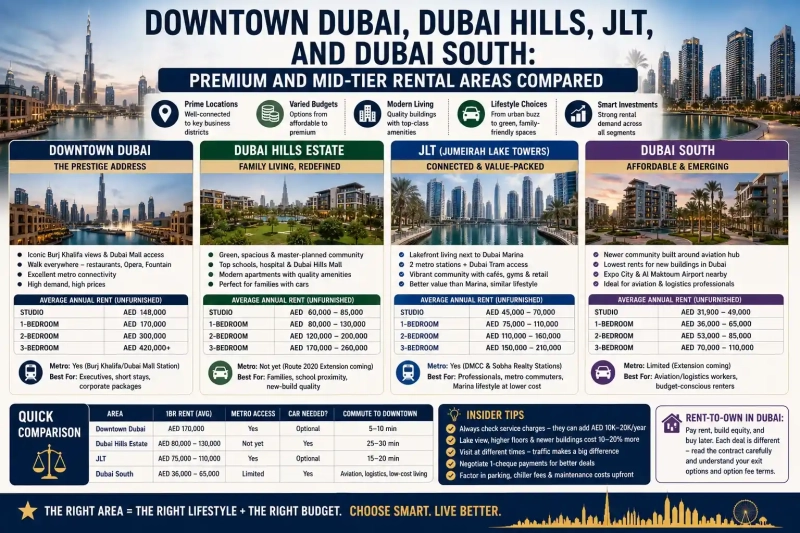
In 2026, a studio in Downtown Dubai runs approximately AED 148,000 per year, a 1-bedroom averages AED 170,000, and a 2-bedroom reaches roughly AED 300,000 annually. To put that in context, the Dubai-wide average for a 1-bedroom apartment is approximately AED 90,000 per year. You are paying nearly double the city average for the Downtown address.
What you receive in exchange is not double the apartment. Typical 1-bedroom units in Downtown run 750–1,000 square feet — comparable in size to what you would find in JLT or JVC at AED 85,000–95,000. The difference is almost entirely the address and the views.
The hidden costs compound the issue. District cooling (chiller) is mandatory in most Downtown buildings and can add AED 5,000–15,000 per year on top of rent. Service charges are high, some buildings charge for parking separately, and Ejari, agency fees, and a security deposit typically add another 5–8% upfront.
The honest assessment: Downtown makes financial sense if your employer is covering it, if you are in Dubai for under twelve months and want the full experience, or if proximity to DIFC and the metro is genuinely central to your work life. For a long-term tenant paying out of pocket, you are subsidising one of the world's most photographed skylines with your own savings.
Dubai Hills Estate: Newer, Greener, Genuinely Family-Oriented
Dubai Hills Estate is Emaar's masterplan development sitting between Downtown and the Marina corridor, accessed via Al Khail Road. It is the area that most directly competes with the traditional premium zones for family renters, and in many cases it wins on liveability metrics that Downtown cannot match: space, greenery, school proximity, and a community feel that high-rise towers rarely deliver.
What the rents actually look like:
Families requiring two bedrooms will find 2-bedroom apartments in Dubai Hills typically range from AED 106,000 to AED 210,000 annually. For 1-bedroom apartments, rents vary from AED 75,000 to over AED 135,000. In 2026, 1-bedrooms run AED 80,000–130,000, and 2-bedrooms AED 120,000–200,000.
At the lower end of those ranges, Dubai Hills delivers something Downtown cannot: a proper community. Dubai Hills Mall is now a fully functioning anchor. GEMS International School, GEMS New Millennium School, and GEMS World Academy are all within the estate, covering various international curricula. King's College Hospital is on the doorstep. The Dubai Hills Park gives children and adults actual outdoor space — not just a gym on the 5th floor.
The trade-offs worth knowing:
The metro situation is the most pressing one. As of 2026, most Dubai Hills residents drive. The Dubai Metro Route 2020 extension includes a Dubai Hills station, though completion timelines have shifted. If you do not own a car, Dubai Hills puts you in a difficult position for daily commuting. Uber and Careem are always available from the mall, but the cost accumulates over a year.
Service charges typically range between AED 14 and AED 18 per square foot depending on the building and amenity level. For a 900 square foot apartment, that is AED 12,600–16,200 per year in service charges on top of your rent — a figure many tenants do not factor into their budget when comparing headline rents.
The bottom line on Dubai Hills: it is the right choice for families who own a car, need school proximity, want new-build quality, and are willing to pay a premium for it — without paying the Downtown premium for something they will never really use.
JLT: The Overlooked Mid-Tier Alternative to Marina
Jumeirah Lake Towers sits directly across Sheikh Zayed Road from Dubai Marina, connected to it by a footbridge. The buildings are similar in scale. The metro access is actually better — two metro stations serve the community: DMCC and Sobha Realty, both connecting to the Red Line and linking to the Dubai Tram network. The lakes and promenades give it a visual character that rivals Marina in its own right. And yet, the rents are meaningfully lower.
What you pay in JLT vs Marina:
Studios in JLT rent for an average of AED 62,460 annually, 1-bedroom units average AED 90,191 per year, and 2-bedroom apartments average around AED 134,169. Compare that to Marina, where a 1-bedroom averages AED 102,284 yearly. For roughly equivalent square footage and comparable metro access, JLT saves you AED 10,000–15,000 per year on a 1-bedroom alone.
JLT is a mixed-use community under the DMCC free zone, with over 24,000 registered companies and an estimated 50,000+ professionals working within the free zone, generating constant residential demand. This matters for renters because it keeps the community alive during business hours and supports a genuine food and retail ecosystem — not just weekend crowds.
What JLT lacks: Direct beach access is the main gap. JBR and Marina Beach are a five-to-ten minute drive, but you will not walk to the water from your apartment. Some buildings are older and maintenance standards vary — lake-view and higher-floor units command a 10–20% premium and tend to attract better-quality management. Service charges in JLT range from AED 12–18 per square foot annually, which is moderate by Dubai standards and significantly lower than Dubai Marina's AED 16–25 per square foot range.
Who JLT works best for: professionals working in Media City, Internet City, JBR, or DMCC itself; anyone who commutes by metro along the Red Line; renters who want the Marina lifestyle at a meaningful discount; and pet owners, since the majority of buildings permit animals and offer ample walking routes along the lakefront.
Dubai South: The Cheapest of the Four — With a Commute That Must Be Planned
Dubai South is the city's southern frontier — a 145-square-kilometre master-planned district built around Al Maktoum International Airport. It has grown significantly since the Expo 2020 cycle and is now a functioning residential community rather than a construction site with aspirations. But it remains, emphatically, a car-dependent area for anyone whose job is in central Dubai.
Rental prices — the city's most affordable for new buildings:
1-bedroom flats in Dubai South are priced from AED 36,000 annually, while studios start from around AED 31,900. Larger 2-bedroom apartments begin at AED 53,000. Studio yearly rents start at AED 42,000 and average approximately AED 49,000. These are genuinely the lowest prices for modern, purpose-built apartments anywhere in Dubai. The buildings are new, the community is clean, and the facilities — pools, gyms, parks — are built into the master plan.
The commute reality:
This is the number that matters most. Dubai South sits about 35–40 kilometres from Downtown Dubai and Business Bay. By car on E311 or E611, a morning commute to central Dubai runs 40–60 minutes in normal traffic, longer during peak hours. There is no direct metro connection to the city centre yet, though the Route 2020 metro line extension to Dubai South is progressing, with its completion being one of the most significant transport upgrades the area will receive.
Until metro access arrives, Dubai South is the right choice for people who work in the southern corridor — aviation, logistics, JAFZA, Expo City Dubai, or DWC itself. For anyone commuting to DIFC or Downtown daily, the rent saving is largely cancelled out by petrol, vehicle wear, and commute time when honestly accounted for.
Rent-to-Own in Dubai: What It Actually Means
Several developers — primarily in emerging communities like Dubai South, Dubai Hills, and newer JVC sub-developments — offer rent-to-own schemes. The concept gets marketed aggressively and is worth understanding precisely before being drawn in by it.
Here is how it actually works: Rent-to-own in Dubai lets you live in a property while gradually building equity without taking a full mortgage upfront. You move in as a tenant, pay a fixed rent, and a pre-agreed portion of that rent counts toward the purchase price. At the end of the agreed term, you decide whether to buy the property or walk away — though an option fee paid upfront is non-refundable if you exit.
Unlike standardised schemes in some Western markets, each deal in Dubai is bespoke, governed by Dubai Land Department registration and RERA oversight. This means you must read the specific contract carefully. The key questions are: what percentage of each monthly payment actually accrues toward the purchase price (often lower than marketing implies), what the agreed locked-in purchase price is relative to current market value, and what happens to your option fee if you decide not to buy.
Rent-to-own is not inherently a bad deal. For renters who are genuinely committed to buying in a specific community but are not yet mortgage-ready, it provides a structured path. For renters who are uncertain about staying in Dubai long-term, it can trap you in a purchase obligation you did not fully anticipate. Treat it as a property purchase decision with a rental wrapper — not as a clever rental upgrade.
Insider Tips
For Downtown: If you are committed to the address, target the Old Town sub-area (Zanzebeel, Kamoon) rather than the Burj-facing towers. The apartments are older but the price-per-square-foot is 15–20% lower, the neighbourhood is quieter, and you still have everything within walking distance.
For Dubai Hills: Collective and Socio developments are the most affordable entry points in the community — compact units from AED 75,000 for a 1-bedroom. If you have children, the Park Heights and Acacia buildings put you closest to the park and within easy walking distance of the school cluster. Always request the service charge schedule before signing.
For JLT: The cluster letter matters more than most renters realise. Clusters near Sheikh Zayed Road (A, B, T, U) give better exit and entry flow. Clusters deep inside the development (M, N, K) are quieter but add 5–10 minutes to every drive. Goldcrest Views and Saba Towers consistently get the best building management ratings from long-term residents.
For Dubai South: Celestia and Tenora by DAMAC are the most established residential buildings and the ones where building management is most consistent. Avoid committing to a long lease without making at least two visits at different times of day — the community is still growing and the experience of living in an area that is 30% occupied is different from one that is 80% occupied.
Quick Comparison Summary
| Area | 1BR Annual Rent | Metro Access | Car Required? | Best For |
|---|---|---|---|---|
| Downtown Dubai | AED 90,000–175,000 | Yes (Red Line) | Optional | Executives, short stays, corporate packages |
| Dubai Hills | AED 80,000–130,000 | Not yet (2026) | Yes | Families, school proximity, new-build quality |
| JLT | AED 75,000–110,000 | Yes (2 stations) | Optional | Young professionals, Marina lifestyle at lower cost |
| Dubai South | AED 36,000–65,000 | Limited | Yes | Aviation/logistics workers, lowest-cost new builds |
The pattern is clear: metro access is still the most powerful rent multiplier in Dubai in 2026. Areas with direct connections command premiums that are almost always justified by the transport saving. Areas without metro access — however appealing on paper — require an honest calculation of what the car costs you every month before the rent figure means anything.
Trying to understand the full picture of Dubai's rental market across every budget tier — from International City and Remraam through to Downtown and the Palm? The comprehensive 2026 guide to Dubai apartments for rent covers every major area, contract types, and the tenant rights most renters only discover after they have already signed