
There's a shift happening among Dubai travelers, and if you've tried booking a flight recently, you've probably felt it already. The casual, spontaneous weekend getaway — the kind where you'd grab a cheap ticket on Thursday night and land somewhere interesting by Friday morning — has quietly become a more complicated and expensive proposition.
This isn't just post-pandemic noise. By mid-2026, the economics of traveling from Dubai have genuinely changed, and the travelers adapting fastest are the ones asking a different question. Not just where can I go? but is this destination actually worth what it costs me in 2026? For those who want a dramatic escape without leaving the UAE entirely, Musandam boat trips offer some of the best value per hour in the region.
Why Everything Feels More Expensive Now
The base fare era is over. What used to be a straightforward ticket price has evolved into a layered puzzle of airport development fees, fuel surcharges, and dynamic pricing algorithms that adjust in real time based on demand. Flight prices from Dubai to popular destinations are running roughly 14% higher than they were just twelve months ago.
Part of this is geopolitical. Regional airspace changes have pushed carriers onto longer, less efficient routes, adding one to three hours to journeys that used to feel like quick hops. A flight that once felt manageable now sits in a different category entirely when you factor in the extra time and the higher fare.
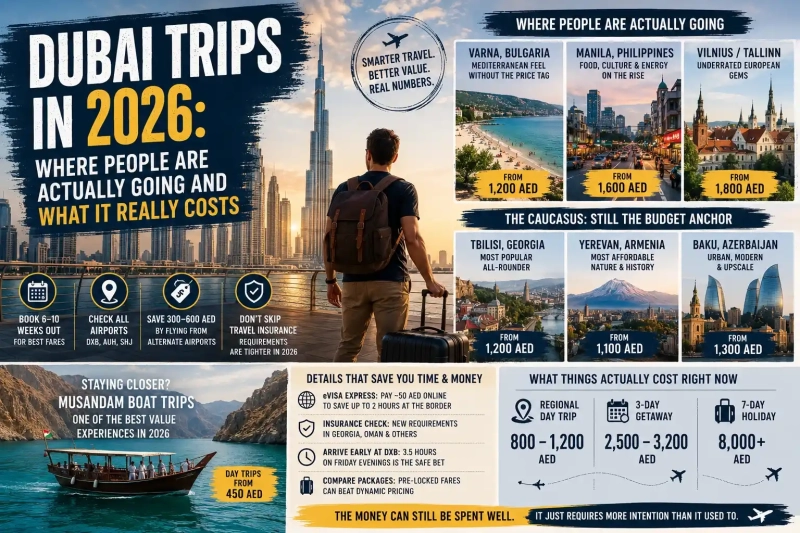
The practical implication is straightforward: waiting for a flash sale is increasingly a losing strategy. In the current market, hesitation almost always means paying more. The travelers getting the best value are booking six to ten weeks out and staying flexible on departure airports — flying from Sharjah or Abu Dhabi instead of DXB can save between 300 and 600 AED on longer routes.
Where People Are Actually Going
The traditional "Big Five" destinations that dominated Dubai travel conversations for years are facing genuine competition. A new set of cities has emerged as the smart choices for travelers who want real experiences without the inflated price tags that come with over-tourism.
Varna, Bulgaria has become the surprise story of 2026. It offers a genuine Mediterranean beach experience — warm water, good food, walkable seafront — at a fraction of what you'd spend on the western European coastline. For families especially, it's hitting a sweet spot that's hard to argue with.
Manila has undergone a reputation transformation. It's no longer just a stopover city. A thriving food scene, a genuinely creative energy in neighborhoods like Poblacion, and the recent attention from major culinary publications have made it a legitimate destination in its own right. A round-trip fare typically lands between 1,600 and 2,200 AED depending on timing, which positions it well against pricier long-haul alternatives.
The Baltic capitals — Vilnius and Tallinn particularly — have quietly inherited the role that Prague and Budapest used to play for budget-conscious European weekenders. Yes, it's a six-hour flight, but the experience-to-cost ratio remains genuinely strong for those willing to commit to the journey.
The Caucasus: Still the Budget Anchor
For anyone working within a 3,000 AED all-inclusive budget, the Caucasus region continues to deliver better value than almost anywhere else accessible from Dubai. Tbilisi remains the most popular all-rounder, though accommodation prices in the Old Town have climbed noticeably over the past year. Yerevan is the most affordable of the three for travelers prioritizing nature, history, and unhurried exploration. Baku suits those who want a more polished, urban experience with upscale dining options.
All three reward longer stays — and if you're wondering why Baku and Yerevan specifically feel rushed on a 48-hour clock, this breakdown explains exactly what goes wrong with short trips to these cities.
The Details That Actually Decide Your Trip
A few practical realities are worth knowing before you book anything.
The visa-on-arrival process at several popular destinations has moved digital, and the queues are often longer than the old paper-based systems. Paying a small fee for an eVisa Express option ahead of travel — sometimes as little as 50 AED — can realistically save two hours at the border. On a short trip, that's an enormous return on a tiny investment.
Insurance requirements have tightened at a number of regional destinations. Georgia and Oman in particular have updated their entry requirements, and policies need to meet current standards. Check this before you travel rather than at the gate.
Airport timing at DXB deserves fresh attention. The traditional two-hour arrival window was already tight; with increased traffic driven by regional events throughout 2026, three and a half hours is the safer standard, particularly on Friday evenings.
Finally, travel packages are worth reconsidering. Managed bundles through agents with pre-locked fares are genuinely competitive against the dynamic pricing you'll encounter booking independently. It's worth the comparison.
What Things Actually Cost Right Now
A regional day trip runs 800 to 1,200 AED. A three-day budget escape lands between 2,500 and 3,200 AED. A seven-day proper holiday starts around 8,000 AED and rises from there depending on destination and comfort level.
For day trips sitting closer to the lower end of that range, Musandam boat packages from Dubai remain one of the strongest value options in 2026 — worth understanding properly before you book.
The money can still be spent well. It just requires more intention than it used to.